IBAS’s Jim Cremin reflects on a new website designed to provide at-a-glace comparison between the differing rules of leading sports betting providers.
IBAS Approached by Rule-Comparison Initiative
read more


By Kevin Pullein
What odds should an accumulator pay?
There is a simple explanation that is right in most situations, but in the others there can be confusion or disappointment.
I will start with the basics and illustrate them using decimal odds.
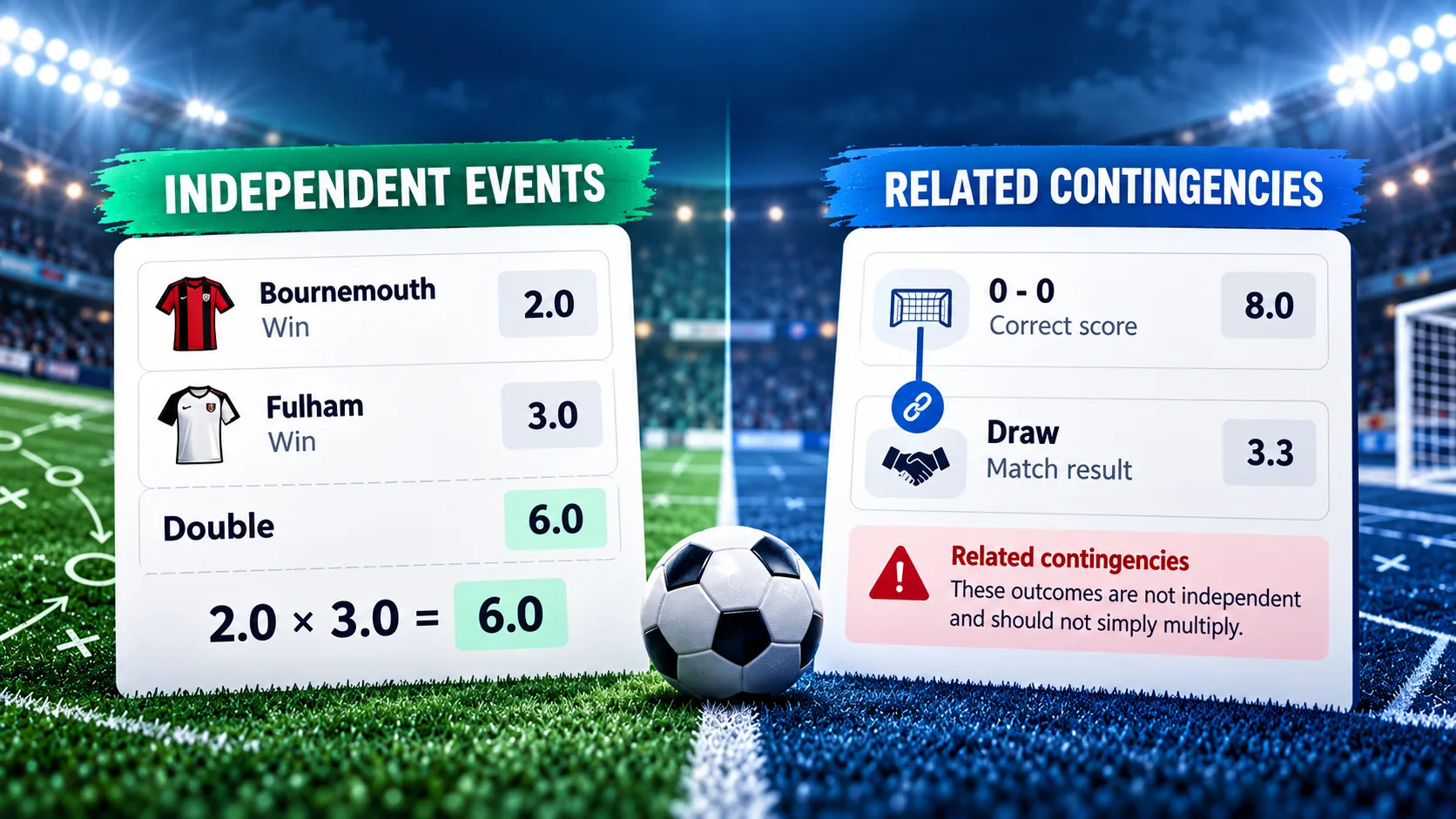
Suppose you could back Bournemouth to win at 2.0 or Fulham to win at 3.0 but you want to back both of them to win.
A successful double would pay 2 x 3 = 6. You multiply the decimal odds together. If you risked £10 your return would be £60 (£10 stake plus £50 winnings).
A successful double pays the first price multiplied by the second price. A successful treble pays the first price multiplied by the second price multiplied by the third price. And so on. This method works for all accumulators in which the outcome of each selection has no bearing on the outcome of any other selection.
Bournemouth winning does not affect the chance of Fulham winning, and Fulham winning does not affect the chance of Bournemouth winning. Statisticians call these independent events. Not every accumulator contains only independent events. Some have what statisticians call dependent events. Bookmakers call them related contingencies.
This is what was written on a slip that developed into a dispute that came to IBAS:
0-0 @ 8.0
Draw @ 3.3
No goals were scored and the bettor asked for payment at decimal odds of 8.0 x 3.3 = 26.4. The bookmaker refused.
These are the questions we need to answer if we want to find the right odds for any double – the complicated ones as well as the simple ones, those with dependent selections as well as those with independent selections.
What are the odds that the first thing will happen, and if it does what are the odds that the second thing will happen?
Let us go back to our previous example. The odds for Bournemouth to win were 2.0, and if they did the odds for Fulham to win would still be 3.0. A win for Bournemouth has no bearing on the chance of a win for Fulham.
Now let us turn back to our other example. If there are no goals a match has been drawn. The odds for a score of 0-0 were 8.0, but if the score was 0-0 the odds for a draw would no longer be 3.3. They would be 1.0, which in practice is the same as saying that the draw selection should be called void, and that is what bookmakers would say. Given the first event, there was no doubt about the second event. It was certain to happen.
Once it has been explained to them I think most reasonable people would understand that a so-called double on 0-0 and a draw is really only a single on a 0-0 draw. But there are circumstances in which the relationship between events is not so obvious. One does not determine the other but does make it more likely.
Take this example of a common type of bet:
Kane to score and England to win
Kane has scored when England drew or lost. Kane scoring does not guarantee England winning. But it does make a victory more likely.
This is why.
A player will score in a certain percentage of a team’s games, but they will not score in the same percentage of wins, draws and losses. Suppose a player scores in 30 per cent of a team’s games. They will not score in 30 per cent of the games the team win, 30 per cent of the games the team draw and 30 per cent of the games the team lose. The proportion of wins in which they score will be higher than the proportion of draws in which they score, and the proportion of draws in which they score will be higher than the proportion of losses in which they score.
This is true of all players and all teams. So if Kane scores England are more likely to win than if he does not score. The odds are now shorter.
Selections from the same game tend to be inter-connected. Changing one thing can change another. Here is a further example:
Arsenal v Tottenham
Arsenal to be shown a red card
Tottenham to win
Teams lose more often when they are shown a red card than when they are not. If Arsenal have a player sent off, Tottenham are more likely to win. The odds are now shorter.
I have made my points with illustrations using doubles but the same principles apply to trebles, fourfolds and upwards. If no selection has a bearing on any other, the right price for the accumulator is found by multiplying together the prices for singles on the selections. Otherwise it is not.
IBAS’s Jim Cremin reflects on a new website designed to provide at-a-glace comparison between the differing rules of leading sports betting providers.
IBAS Panel Member Kevin Pullein reflects on how the dramatic twist to the 2025/26 Championship play-offs affected three clubs and many more bettors.